Magazine

Magazine

Short reads on the science of attention: what it costs to lose it, and what it takes to protect it.

Episode 08

Your brain can only do one thing at a time
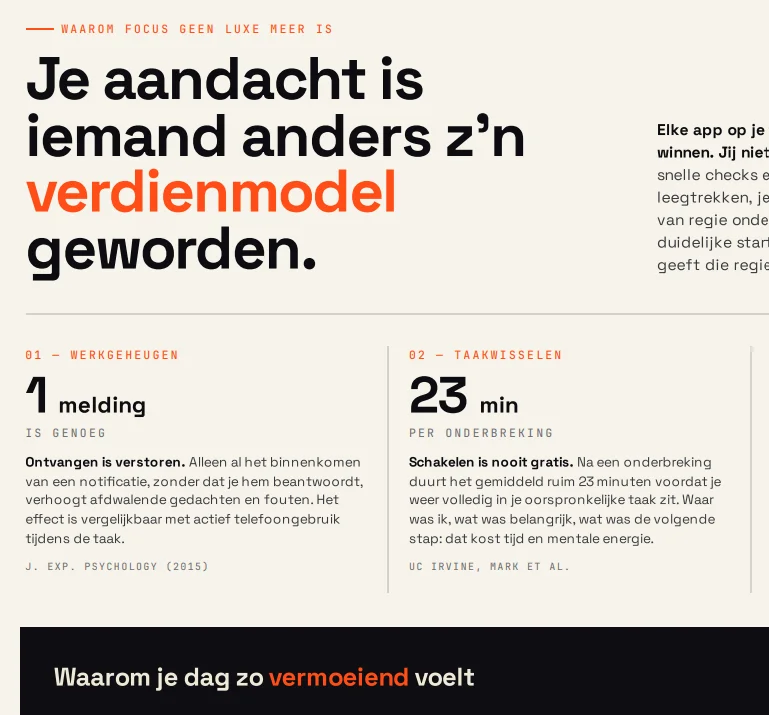
You're deep in an important task. A message appears. A quick look, two lines read, phone back down. Ten seconds at most. To you it feels like nothing. To your brain it's a different story. Psychologist and neuroscientist Elke Geraerts explains in an interview with Het Belang van Limburg how much pressure our concentration is under. Office workers switch activities every few minutes on average, research shows. One email, WhatsApp message or colleague is enough to move attention elsewhere. After that, the brain has to find its way back to where it left off. The problem sits less in those few seconds of distraction than in what happens next.

Episode 07

The science behind minagi, in one infographic

We gathered the research behind minagi on a single page: working memory, task switching, attention training, and the numbers that show why bounded attention hands you back control. Download the infographic and keep it, print it, or pin it next to your desk.

Episode 06

What a single tone does to your brain
Strike a brass singing bowl and something remarkable happens. The tone swells, lingers for seconds, and then slowly fades away. Your ear follows it all the way to the last trace of vibration. A beep from a phone does the exact opposite: it yanks your attention loose and vanishes within a second. That difference in character is why researchers have now spent twenty years studying the singing bowl seriously. They're after the answer to a simple question: what does a tone like that do to a person?

Reading list · 01

The book that teaches you where your attention actually goes
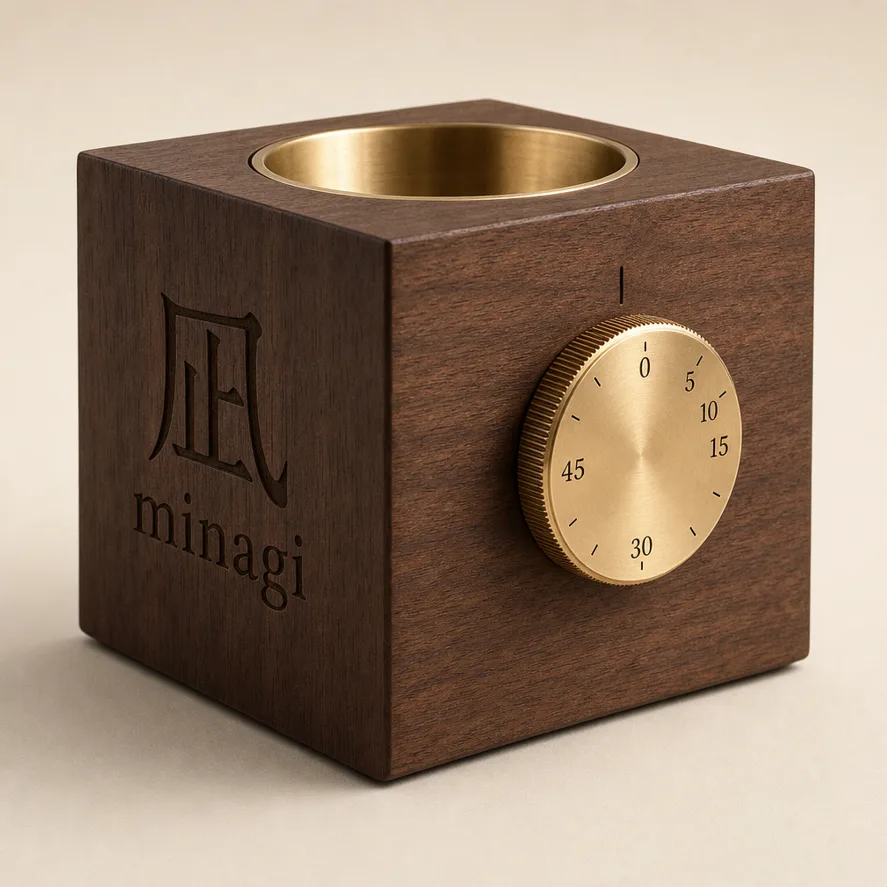
Chris Bailey spent a year obsessing over his own productivity and came back with an uncomfortable conclusion: the problem is rarely your calendar. It's your attention. Hyperfocus is the manual that goes with it.

Episode 05

Why we built a timer without a screen, without an app, without power

Ask the question out loud and it sounds almost strange. Why build a separate object for something your phone already does? Every smartphone contains a timer. Free, always at hand, accurate to the second. We built one anyway. Of walnut and brass, mechanical, without a screen and without a plug. This episode explains why that apparent detour turns out to be the shortest route to attention.

Episode 04

Focus is about more than performing. It's also about recovering

The word focus conjures images of tight deadlines and full to-do lists. Performance, productivity, output. That association misses half the story. The same attention that carries deep work also carries rest, breathing and recovery. Attention is just as much a form of self-care as a disciplined morning routine or a warm bath. And the science backs it up better than most wellness promises do.

Episode 03

Studying with your phone on the table is studying with the handbrake on

Exam week. In front of you, a stack of summaries; beside you, your phone. Screen down, sound off, tidy. You think: surely it can barely bother me like this? The science says something surprising. Just by lying there, it slows you down. You're studying with the handbrake on, and barely notice.

Episode 02

Why your day feels so exhausting, with so little to show for it

Half past five. You close the laptop and tally the day's harvest. Three half-finished tasks, an inbox that only grew, and a presentation still waiting for you. You feel as drained as if you'd run a marathon. Sound familiar? The explanation is subtler than laziness or an over-full calendar. It sits in the wiring of your brain.

Episode 01

Every time you pick up your phone, you've already lost

Tuesday morning, quarter past nine. In front of you sits the most important piece of work this week: the presentation for your job. You pour coffee, pick up your phone and open a focus app. Timer set to 25 minutes. Feel the irony? You're asking the device that lives off your distraction to guard your concentration. The butcher inspecting his own meat.