
The book that teaches you where your attention actually goes
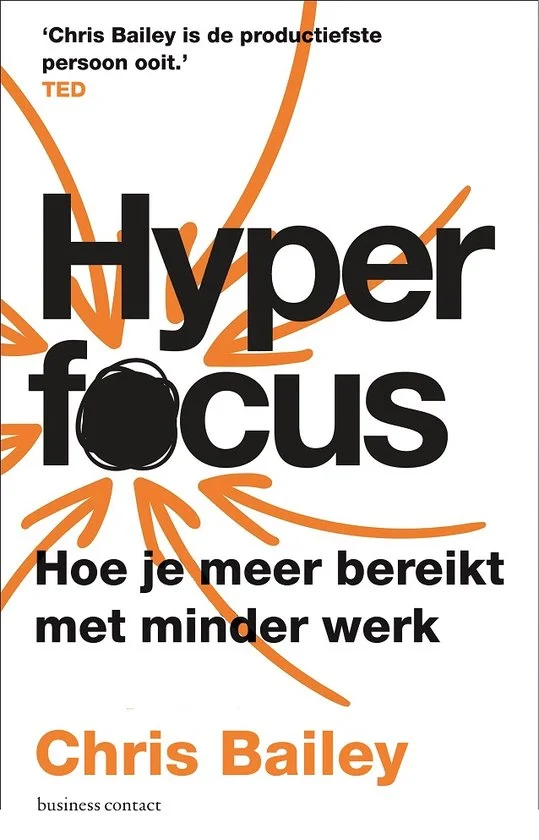
Chris Bailey spent a year obsessing over his own productivity and came back with an uncomfortable conclusion: the problem is rarely your calendar. It's your attention. Hyperfocus is the manual that goes with it.
One thing at a time, literally
Bailey opens with a fact that colors everything after it: your working memory, what he calls your attentional space, is small. It holds roughly one complex task, plus a bit of peripheral awareness. Answering email during a conversation isn't really doing two things halfway, it's switching at speed between two things that each demand the full space. Every switch costs working memory, and you feel that loss by the end of the day as tiredness with nothing to show for it.
The research Bailey cites makes it concrete: at a computer, we work on something for under a minute on average before we switch or get interrupted. Not because we're weak, but because our brain rewards novelty. Every notification, every tab, every stray thought gives a small hit of dopamine. Distraction isn't a character flaw, it's biology with a business model built around it.
Hyperfocus is a choice, not a talent
The core of the book is a four-step ritual. Choose one object of attention in advance: one task, deliberately picked, not the first one shouting for your attention. Clear the field before you start: phone away, tabs closed, because willpower in the moment always loses to a design built to win. Focus for a set stretch of time. And bring yourself back: your thoughts will wander, dozens of times per session on average, and noticing that isn't failure, it's exactly the training.
Wandering isn't failure. Noticing it and bringing your attention back is the exercise itself.
The surprise: wandering on purpose
What sets Hyperfocus apart from the average productivity title is its second half. Bailey argues just as hard for scatterfocus: letting your attention wander deliberately, on a walk, in the shower, notebook in hand. That's where your brain connects loose ends, where ideas and plans surface that never arrive at a desk. Focus and wandering aren't opposites, they're two settings on the same instrument. Train only the first, and you get efficient but rarely original.
The lessons in five lines
01 · Attention is your scarce resource, not time
Your attentional space holds one complex task. Plan your attention the way you plan your calendar.
02 · Choose one object of attention in advance
A deliberate intention turns an hour of being present into a session with an outcome.
03 · Clear distraction before you start
Settle the fight in advance: phone out of sight, environment ready. In the moment, you rarely win it.
04 · Bringing it back is the training
Your mind wanders, always. Notice it, return. Every return makes the next one easier.
05 · Plan your wandering time too
Scatterfocus, deliberate wandering, is where ideas and perspective come from. Protect it as carefully as your focus.
Why you should read this book
Because it's level-headed. Bailey doesn't promise a five-hour morning routine or a life without a phone. He builds on attention research, tests everything on himself first, and admits what stays hard. And because it goes beyond performance: learning to direct your attention changes how you experience your day. Calmer, fuller, more your own. That makes Hyperfocus less a productivity book and more a book about the quality of your hours.
Bailey's recipe turns out to be surprisingly physical: pick a task, pick a duration, put your phone out of reach, and give your session a clear start and end.
We poured exactly that ritual into walnut and brass. Turn minagi's dial, and the chapter can begin.
- Book
- Hyperfocus
- Author
- Chris Bailey
- Year
- 2018