
What a single tone does to your brain
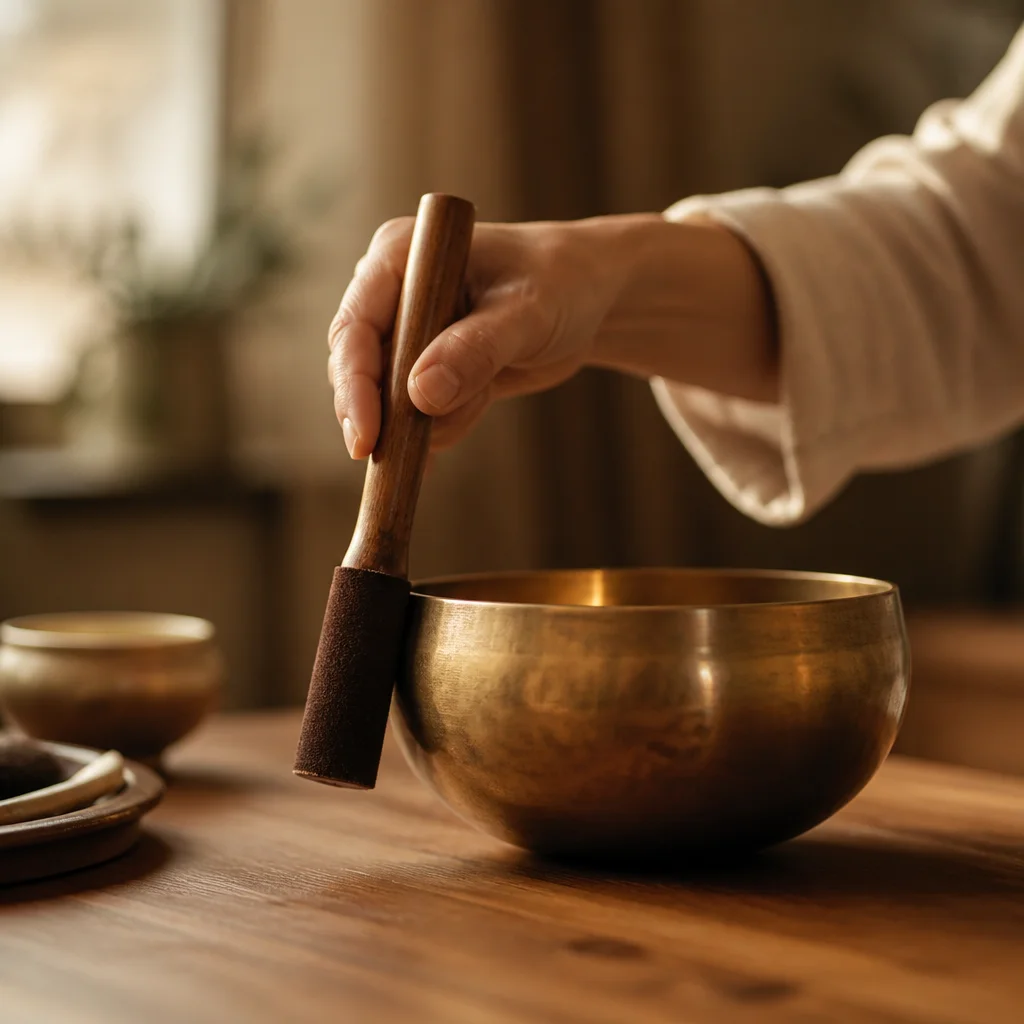
Strike a brass singing bowl and something remarkable happens. The tone swells, lingers for seconds, and then slowly fades away. Your ear follows it all the way to the last trace of vibration. A beep from a phone does the exact opposite: it yanks your attention loose and vanishes within a second. That difference in character is why researchers have now spent twenty years studying the singing bowl seriously. They're after the answer to a simple question: what does a tone like that do to a person?
Why brass sounds different from a beep
Cast brass vibrates at multiple frequencies at once. Overtones ring above the fundamental, and tiny irregularities in the wall produce two nearly identical frequencies. Those two reinforce and cancel each other in a slow rhythm, which is the soft wavering you hear. On top of that, the tone decays over many seconds. Your hearing system gets time to move with it instead of being startled. The shape of the sound carries the calm, more than the volume does. A buzzer is a single frequency that starts abruptly and stops abruptly. You feel the difference in your body.
The brain switches gears
Researchers use EEG to measure what a tone like this does inside the head. A Korean team had participants listen to singing bowl sound and saw the slow delta and theta waves increase, while the fast beta and gamma waves dropped at the same time. Slow waves go with deep relaxation and meditation. Fast waves go with alertness, tension and rumination. German research into singing bowl massage found the same pattern and described the resulting state as more mindful and meditative. The brain drops out of doing-mode, within minutes, without any effort from the listener.
The heart listens too
The response reaches further than the head alone. American researcher Landry compared a Himalayan singing bowl with silence in 51 adults. After the tone, both heart rate and systolic blood pressure dropped measurably more than after sitting quietly (p = 0.003 and p = 0.044). A 2025 systematic review of fourteen studies found the same pattern: higher heart rate variability and a lower heart rate. Both point to a more active vagus nerve, the nerve that shifts your body into rest mode. Your ear hears the tone, and your heart rhythm adjusts.
The sharpest trial so far
The strongest study comes from Chile. Researchers randomly split fifty people with elevated tension into three groups: fifty minutes of singing bowls, fifty minutes of progressive muscle relaxation, or sitting quietly. The singing bowl group showed the clearest shift in brain activity and the strongest rise in heart rate variability, plus the biggest drop in anxiety. A single session was enough. That outperformed an established relaxation method from clinical practice. The researchers note the advantage that a singing bowl needs almost no instruction: listening is enough.
A young field with a clear direction
To be fair, this research field is still young. A 2020 review found only four usable studies. The 2025 review counted fourteen, with small groups and widely varying designs, and rated the certainty of the evidence as low to moderate. What stands out is its consistency. Nearly every study points the same way: less tension, a calmer heart, a quieter brain. Larger, more tightly designed trials will pin down the exact size of the effect later. The foundation is there.
Why a focus block ends with a tone
This is why minagi carries a tuned brass bowl instead of a buzzer. A beep yanks you out of concentration and briefly spikes your heart rate. A warm tone that slowly fades escorts you out instead. The sound marks the end of your attention block while inviting your nervous system to settle at the same time. The end of focus as the start of rest, in a single vibration between 400 and 500 hertz. That's exactly why we chose solid brass, hand-tuned.
Sources
- Kim, S.-C. & Choi, M.-J. (2023). Does the Sound of a Singing Bowl Synchronize Meditational Brainwaves in the Listeners? International Journal of Environmental Research and Public Health, 20(12), 6180.
- Walter, N. & Hinterberger, T. (2022). Neurophysiological Effects of a Singing Bowl Massage. Medicina, 58(5), 594.
- Landry, J. M. (2014). Physiological and Psychological Effects of a Himalayan Singing Bowl in Meditation Practice: A Quantitative Analysis. American Journal of Health Promotion, 28(5), 306-309.
- Rio-Alamos, C., Montefusco-Siegmund, R., Cañete, T., Sotomayor, J. & Fernandez-Teruel, A. (2023). Acute Relaxation Response Induced by Tibetan Singing Bowl Sounds: A Randomized Controlled Trial. European Journal of Investigation in Health, Psychology and Education, 13(2), 317-330.
- Goldsby, T. L., Goldsby, M. E., McWalters, M. & Mills, P. J. (2017). Effects of Singing Bowl Sound Meditation on Mood, Tension, and Well-being: An Observational Study. Journal of Evidence-Based Complementary & Alternative Medicine, 22(3), 401-406.
- Lin, F.-W., Yang, Y.-H. & Wang, J.-Y. (2025). Effects of Tibetan Singing Bowl Intervention on Psychological and Physiological Health in Adults: A Systematic Review. Healthcare, 13(16), 2002.
- Stanhope, J. & Weinstein, P. (2020). The Human Health Effects of Singing Bowls: A Systematic Review. Complementary Therapies in Medicine, 51, 102412.
Figures and effects in this article refer to published research on singing bowls and sound interventions. They describe the outcomes of that research, separate from the minagi product itself. Effect sizes vary by study, population and measurement method.
← Back to Magazine